Monday, May 31, 2010

Monday Musings


Sojourners Adult Bible Class

Sunday morning was bitter sweet. I finished John chapter 3 in the Sojourners class. We saw that Jesus was the perfect witness for the Father. He came to reveal the Father to us. We saw that Jesus can speak of the things of God because He has first hand knowledge of God and heavenly things. That ties back to the startling statement that Jesus made to Nicodemus – “unless one is born from above, or “fathered” from God one cannot see nor enter the kingdom of heaven. Jesus came to reveal those things from above or from heaven.

Therefore Jesus is to be believed for three reasons. The first is that He is from above as we have mentioned so He has perfect, complete, and experiential knowledge to reveal. Second, because the Father has given to Jesus the Holy Spirit without limit to teach, reveal, and testify of the heavenly things necessary for salvation. Third, the end result is so important – if one believes present tense, continues to believe one has eternal life, if one does not believe the wrath of God that one was conceived and born under remains for ever.

This was my last class with the Sojourners. At least for some time. I have taught for almost three years and have loved every minute. We have had some tremendous times in the Word together. I shall miss the teaching outlet.

Sunday Morning Message

Our pastor is currently going through Ephesians. This morning we examined chapter 3:1-13. He reminded us that Paul was chained in the Mamertine Prison as a prisoner of Christ. Paul didn’t complain and say he was a prisoner of Rome, but of Christ for the sake of the Ephesians. Paul was a prisoner to reveal the mystery of how God would bring both Jews and Gentiles into one body through a marvelous plan of redemption.

This mystery was not known prior to God’s sovereign timing of revealing it to Paul who in turn revealed this mystery to the churches, particularly the Ephesian church. Paul considered himself the least of saints, unworthy of this privilege.

God engineered this wonderful plan in such a way that all would marvel, including the angels. The angels are amazed at how God has worked out a plan of redemption for the elect. So Paul did not want the Ephesians believers to worry or be discouraged because he was a prisoner for preaching the gospel.

Sunday afternoon

It was a short drive home and a very lazy afternoon. Irene fixed sausage dogs the way I like them (mustard and onions please) and French fries. We then determined that we were not going anywhere the rest of the day and we figured no one else was coming over so we resumed out project of “offing” our tremendous VHS collection of movies. We jammied up and made three piles of movies. Pile one was, we know we are not keeping this one, pile two was, hmm, let’s watch and see if it makes the cut, and pile three was, we are definitely keeping.

We watched The Talented Mr. Ripley and decided the language and material was not suitable so it was moved from the let’s see if it makes the cut to the get rid of pile. We then watched Sweet Dreams, the Patsy Cline story. The opening scenes were not all that wholesome but the rest of the movie was very interesting and the sound track was of this world. So, it is going to stay for a bit.

Supper was a peanut butter sandwich and a glass of milk. Irene and I talked about a few things for awhile. She went to bed early to read. I settled in and read from Wayne Grudem’s Systematic Theology.

The old man  (Theophilus) laid on the top of the couch and just slept while I read. While Miss Thing, (Coco ) played with her pink mouse.

All in all, it was a good Sunday! How was yours?

Sunday, May 30, 2010

Is the World Looking for God?

Alistair Begg is the Senior Pastor of Cleveland's Parkside Church (located in Bainbridge, Geauga County, Ohio), a position he has had since 1983, and is the voice behind the Truth for Life Christian radio preaching and teaching ministry that broadcasts his sermons daily to stations across the U.S. He is also the author of several books and has played one small role as a film actor.

Begg is a strong advocate of historic Protestant Evangelical theology. He stresses the importance of believing the Bible to be the completely authoritative Word of God, and the importance of using the mind to know the Bible and knowing God through repentance and faith in Jesus.


Saturday, May 29, 2010

Food Choices & My Favorite Bible Verse...


Tim Hawkins is a good clean comedian.

Some things are funny and some things just aren’t! Have you ever been to a comedy show and felt embarrassed by the base and crude humor that is spewing from the mouth of the comedian? I have often wondered why people seem to think that vulgarity and filth are funny, perhaps some would just call me to puritanical, but I have always been impressed by those who can invoke laughter without using base insinuations. In my search for some good clean fun, I stumbled upon a wonderful clean comedian, Tim Hawkins.


Friday, May 28, 2010

The Gift of God's Word Part III

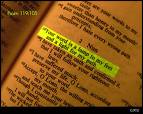
ARENA OF THE 119TH PSALM

In other words, what area of life is this Psalm dealing with?

Jonathan Edwards wrote: “I know of no part of the Holy Scriptures where the nature and evidences of true and sincere godliness are so fully and largely insisted on and delineated as in the 119th Psalm. The Psalmist declares his design in the first verses of the Psalm, keeps his eye on it all along and pursues it to the end.”

This psalm may be considered as the statement of a believer's experience. As far as our views, desires, and affections agree with what is here expressed, they come from the influences of the Holy Spirit, and no further.

The pardoning mercy of God in Christ is the only source of a sinner's happiness. Everyone wants to be happy don’t they? Everyone goes to great lengths to find happiness and even further lengths to remain happy. So we think that position, power, possessions, pursuits, programs, popularity, promiscuity, pretense, passion, promise, or promotion, especially of self will bring us happiness.

The tragedy is that happiness comes from a word that means happenstance. Happiness comes from favorable circumstances. So if the circumstances are favorable or to our liking or desires, then we are happy. But if the favorable circumstances are removed then happiness is lost.

What is true happiness? Or more importantly where is it found? Well, again, the pardoning mercy of God in Christ is the only source of a sinner's happiness. So then the next question then should be, well how do I maintain this happiness or what the bible calls joy? The answer is in this Psalm.

Those are most happy, who are preserved most free from the defilement of sin, who simply believe God's testimonies, and depend on his promises. If the heart be divided between God and the world, the heart is evil. But when the saints carefully avoid all sin; they are conscious of much evil that clogs them in the ways of God, but not of that wickedness which draws them out of those ways.

The Devil would make men think they can be happy without being free from sin, without believing God’s testimonies, or without being fully dependent on God’s promises. The Devil would make men think they are at liberty to follow the word of God or not follow it, as they please. But the desire and prayer of a godly man agrees with the will and command of God. Did you get that?

Isn’t this what Jesus taught? "If you ask me anything in my name, I will do it." (John 14:14, ESV)  "Until now you have asked nothing in my name. Ask, and you will receive, that your joy may be full." (John 16:24,ESV)

What does it mean to ask in Jesus name? To ask according to His authority, His power, His will and wishes.
So the desire & the prayer of a godly man agrees with the will and command of God.

If a man expects by obedience in one thing to purchase indulgence for disobedience in others, his hypocrisy will be detected; if he is not ashamed in this world, everlasting shame will be his portion.

The psalmist coveted, he yearned, and his whole being was given over to learn the laws of God and to give God the glory. And true believers understand that if God forsakes them, the temper will be too hard for them. (Ps 119:9-16)

The one theme is the word of the Lord. The Psalmist sets his subject in many lights, and treats it in many ways, but he seldom omits to mention the word of the Lord in each verse under some one or other of the many names by which he knows it; and even if the name be not there, the subject is still heartily pursued in every stanza. He who wrote this wonderful song was saturated with those books of Scripture which he possessed.

So, the arena covers the spiritual dynamics that are designed to lead God’s people into a full, abundant, joyful, and yet humble and obedient life to the praise and glory of God!

Do you want to live a full life? Do want an abundant life, a life that is filled with joy? The blue-prints, the schematics, the directions, and the steps are right here in the word of God, especially in this particular Psalm!

APPLICATION OF THE 119TH PSALM

Andrew Bonar tells of a simple Christian in a farmhouse who had meditated the Bible through three times. This is precisely what this Psalmist had done; -- he had gone past reading into meditation.

Like Luther, David had shaken every fruit tree in God's garden, and gathered golden fruit there from.

"The most, "says Martin Boos, "read their Bibles like cows that stand in the thick grass, and trample under their feet the finest flowers and herbs." It is to be feared that we too often do the like. This is a miserable way of treating the pages of inspiration. May the Lord prevent us from repeating that sin while reading this priceless Psalm?

There is very evident growth in David’s understanding of the subject of the word of God. That is our application, to more fully understand the words of God and to live them. To grow in the grace and knowledge of the Lord and His almighty, powerful, and majestic word.

Ultimately, what is the application of the whole bible? I think it can be summed up this way; we are to live our lives fully pleasing unto God, fruitful in every good work, crucifying the passions of the flesh, and reflecting and magnifying the glory of God. In order to do these things we must know His revealed will and obey it.

We must believe these words from Charles Spurgeon:

“This sacred ode is a little Bible, the Scriptures condensed, a mass of Bibline, Holy Writ rewritten in holy emotions and actions. Blessed are they who can read and understand these saintly aphorisms; they shall find golden apples in this true Hesperides, and come to reckon that this Psalm, like the whole Scripture which it praises, is a pearl island, or, better still, a garden of sweet flowers.”

Thursday, May 27, 2010

The Gift of God's Word Part II

AUTHOR OF THE 119TH PSALM

This Psalm does not name its author nor does it give us the reason why it was written. It doesn’t even have a title. Most scholars believe it was written by David. The argument goes like this; after you read David’s writings a number of times in the Psalms that are attributed to David you can begin to get a feel for the style, language, and feeling that distinguishes his writings. Most people believe that you can sense David throughout this Psalm.

Charles Spurgeon wrote: “The fashion among modern writers is, as far as possible, to take every Psalm from David. As the critics of this school are usually unsound in doctrine and unspiritual in tone, we gravitate in the opposite direction, from a natural suspicion of everything which comes from so unsatisfactory a quarter. We believe that David wrote this Psalm. It is Davidic in tone and expression, and it tallies with David's experience in many interesting points. In our youth our teacher called it "David's pocket book” and we incline to the opinion then expressed that here we have the royal diary written at various times throughout a long life. No, we cannot give up this Psalm to the enemy. "This is David's spoil". After long reading an author one gets to know his style, and a measure of discernment is acquired by which his composition is detected even if his name be concealed; we feel a kind of critical certainty that the hand of David is in this thing, yea, that it is altogether his own.”

Though we don’t have evidence or proof, this Psalm is general considered to be authored by David. Of course many others including Daniel and Ezra have also been suggested by some as a possible author. I think this Psalm is from David’s pen. But it doesn’t really matter does it? The Holy Spirit is the author, it is inspired, profitable, and has been preserved by God’s grace for our benefit.

ARRANGEMENT OF THE 119TH PSALM

For the record, there is no real outline for this Psalm. There are different key features or subjects that are touched on throughout the Psalm. Some of those features are touched upon repeatedly.

Psalm 119 is considered to be an acrostic Psalm. It is composed of twenty two sections, with each section containing eight (8) lines. All eight (8) lines in each section begin with the same letter from the Hebrew alphabet. The author continues using each letter of the Hebrew alphabet until all twenty-two (22) letters are used.

Nathaniel Hardy, (1618-1670) made this observation, "that the 119th Psalm is disposed according to the letters of the Hebrew alphabet, perhaps to intimate that children, when they begin to learn their alphabet, should learn that Psalm." Children could learn the Hebrew alphabet and this Psalm at the same time.

Each of the eight (8) verse stanzas are begun by the letters of the Hebrew alphabet. We don’t see this in English. So, let me write the first eight verses as they were when David wrote them so you can get a feel for this: (This is verses 1-8)

A blessing is on them that are undefiled in the way and walk in the law of Jehovah;

A blessing is on them that keep his testimonies, and seek him with their whole heart;

Also on them that do no wickedness, but walk in his ways.

A law hast thou given unto us, that we should diligently keep thy commandments.

Ah! Lord, that my ways were made so direct that I might keep thy statutes!

And then shall I not be confounded.While I have respect unto all thy commandments.

As for me, I will thank thee with an unfeigned heart, when I shall have learned thy righteous judgments.

An eye will I have unto thy ceremonies, O forsake me not utterly.

Wednesday, May 26, 2010

The Gift of God's Word

What can we say about the 119th Psalm? This Psalm is a Psalm in its own class and it is not like any of the other Psalms. It outshines and excels them all. This Psalm praises God for His Word – because God has given us the bible and it is only through the bible that we can come to know who God is and how to praise Him.

In a sermon from 1661 it was called a star in the firmament of the Psalms, of the first and greatest magnitude. That same sermon went on to say, that this Psalm is made up of three things: 

• Prayers to God

• Praises of God

• Protestations unto God 

Johannes Paulus Palanterius in 1600 called it “the alphabet of divine love, the paradise of all doctrines, the storehouse of the Holy Spirit, the School of truth.”

Franz Delitzsch of the German OT commentary, Keil & Delitzsch said that the German version had the appropriate inscription, “The Christian’s golden A B C of praise, love, power, and use of the Word of God.” “Here we have set forth in inexhaustible fullness what the word of God is to a man and how a man is to behave himself in relation to it.”

Matthew Henry gave instructions concerning this particular Psalm, he said “that we are to meditate on one verse each morning, and thus mediate through this Psalm twice a year” and he believed that this would bring us to be in love with all the rest of the Scriptures.

Augustine, who left us voluminous commentary on the bible, commented on this particular Psalm last, and only after much urging of his friends, “... because as often as I essayed to think thereon, it always exceeded the powers of my intent thought and the utmost grasp of my faculties.”  I can't even imagine anything to be beyond the grasp of this man's faculties.

William De Burgh wrote in 1860, “... it applies an all-containing medicine to the varied spiritual diseases of men – sufficing to perfect those who long for perfect virtue, to rouse the slothful, to refresh the dispirited, and to set in order the relaxed.”

At one time or another we all qualify for this – as children of God we should long for “perfect virtue, we need periodically to be roused from our sleepiness, we certainly from time to time need to be refreshed.

And if you were to be tempted to regret or complain about the length of this Psalm as you study it or even memorize it, then remember this little tribute to its length:

George Wishart, the chaplain and biographer of the Marquis of Montrose, was on the scaffold of the gallows that was to hang him. In keeping with the custom of the day, the condemned prisoner was allowed to choose a Psalm to be sung. He chose the 119th Psalm. Before 2/3 of the Psalm was sung, a pardon arrived which spared his life.

Charles Spurgeon adds this little tid-bit that the choice of this Psalm wasn’t necessarily made because of Wishart’s spirituality as much as it was made for shrewdness to gain as much more time as possible while he waited on his pardon. 

Martin Luther said – “…he prized this Psalm so highly that he would not take the whole world in exchange for one leaf of it.”

Derek Kidner – “This giant among the Psalms shows the full flowering of that ‘delight…in the law of the Lord’ which is described in Psalm 1 and gives its personal witness to the many-sided qualities of Scripture praised in Psalm 19.” 

Countless books, sermons, and writings have been done on this Psalm – Charles Spurgeon in his Treasury of David wrote 349 pages about it; Charles Bridges wrote some 481 on this one Psalm, Thomas Manton wrote three (3) volumes on this Psalm totaling 1677 pages. 

What makes this Psalm unique is its theme – the word of God. God’s word is mentioned in every verse except a couple. The Masoretes stated that the Word of God is referred to in every verse except verse 122.

Derek Kidner states God’s word is mentioned in every verse except 84, 121, and 122. Boice seems to think God’s Word is not mentioned in verses 90 & 132 – but he says 171 of 176 verses mention God’s Word.

According to H. C. Leupold the writer must have determined to do three (3) specific things when he wrote this Psalm: 

• Resolved to address God throughout this Psalm, except maybe the first three (3) verses

• Resolved to make mention of the Law of God in one way or another thought most of this Psalm

• Resolved for some reason to make this Psalm an acrostic, by using eight (8) verses which begins with the letters of the Hebrew alphabet

Let me encourage you to spend some time reading this Psalm. Use it as a prayer guide to learn to love, cherish, and teasure the word of God as this Psalmist did. Come to love it and be fed from its great depth of nourishment.

Tuesday, May 25, 2010

Are You Settled In Doctrine?

Col 1:23, “if indeed you continue in the faith, grounded and steadfast …” 

Charles Spurgeon wrote these words, “I am persuaded that the use of a good catechism in all our families will be a great safeguard against the increasing errors of the times … those who use it in their families or classes must labor to explain the sense, but the words should be carefully learned by heart.”

Thomas Watson said, “It is the duty of Christians to be settled in the doctrine of faith.”

It is easy to see from biblical writers and from the apostles that they desired that believer’s be grounded and settled in their faith and in Christian doctrine. For example:

Peter - “And after you have suffered a little while, the God of all grace, who has called you to his eternal glory in Christ, will himself restore, confirm, strengthen, and establish you.” (1Pe 5:10 ESV)

Jude - “wild waves of the sea, casting up the foam of their own shame; wandering stars, for which the gloom of utter darkness has been reserved forever.” (Jude 1:13 ESV)

Jude did not want his readers to be like the false teachers who were like shooting stars or meteors falling through space, but to be like the stars that are fixed in their place. To many Christians are all over the board.
Aristotle made this comment about these false teachers being likened to wandering stars:

“They do leap up and down, and wander into several parts of the heaven; and being dry exhalations, not made of that pure celestial matter as the fixed stars are, they often fall to earth.”

The principle that we so clearly see is that since these false teachers are not settled or grounded in Christian doctrine, they will at various times, just like falling stars, change opinions and doctrines. Why? They are unsettled and ungrounded in what they believe.

Paul wrote - “so that we may no longer be children, tossed to and fro by the waves and carried about by every wind of doctrine, by human cunning, by craftiness in deceitful schemes.” (Eph 4:14 ESV)

Paul compares unsettled or ungrounded believers to children. We all know how fickle and easily distracted children are. They think one thing this minute and in the next minute they are thinking something different. Children are easily misled because they haven’t matured in their thinking. So unsettled, ungrounded Christians are like children. I don’t think there is any doubt as to how important it is that we as believers, for our own good and for God’s glory, be settled and grounded in Christian doctrine.

The Purpose of Preaching the Word

Why do we preach the Word of God? The answer is quite simple actually: The aim, the purpose, the goal of teaching and preaching is to ground each and every believer in the doctrines of our Christian faith.

For the last several years there has been this belief and fear that doctrine is somewhat evil, that doctrine divides rather than unifies, that doctrine is unnecessary to the purpose of God and Christ. This idea has become a banner, a rallying point for those who first do not understand biblical doctrine. Believers fail to see how important doctrine is. And I am talking about biblical doctrine, not man made, nor denominational preferences or opinions.

Listen to Paul as he writes to the Christian church at Ephesus: "And he gave some, apostles; and some, prophets; and some, evangelists; and some, pastors and teachers; (why Paul, why did God give pastors and teachers?) For the perfecting of the saints, for the work of the ministry, for the edifying of the body of Christ: (Till we all come in the unity of the faith, and of the knowledge of the Son of God, unto a perfect man, unto the measure of the stature of the fullness of Christ: That we henceforth be no more children, tossed to and fro, and carried about with every wind of doctrine, by the sleight of men, and cunning craftiness, whereby they lie in wait to deceive;" (Eph 4:11-14)

When you hear a bible text explained it is for the purpose of further grounding you in the Christian faith. Do you avail yourself of this purpose? Do you allow the word to complete its work?

Why do you sit and listen to a sermon? The end result of the passage exegetically explained and accurately applied is to further your understanding of God, His Word, His will, His character, His nature, and His plan. Preaching and teaching is the most important thing a church can do.

Jeremiah knew this – he saw the word of God like a hammer. (Jer 23:29). Every blow of the hammer is to fasten the nails of the building, right? Every true word taught is to fasten you more to Christ.

The purpose of preaching the word is to enlighten you and to establish you and keep you in the right way. If you are not settled, established, and grounded then you are not responding to the end result of the teaching and preaching of the word of God.